LAYER 01 PRESENTATION & SHARING
Help learners share achievements with context.
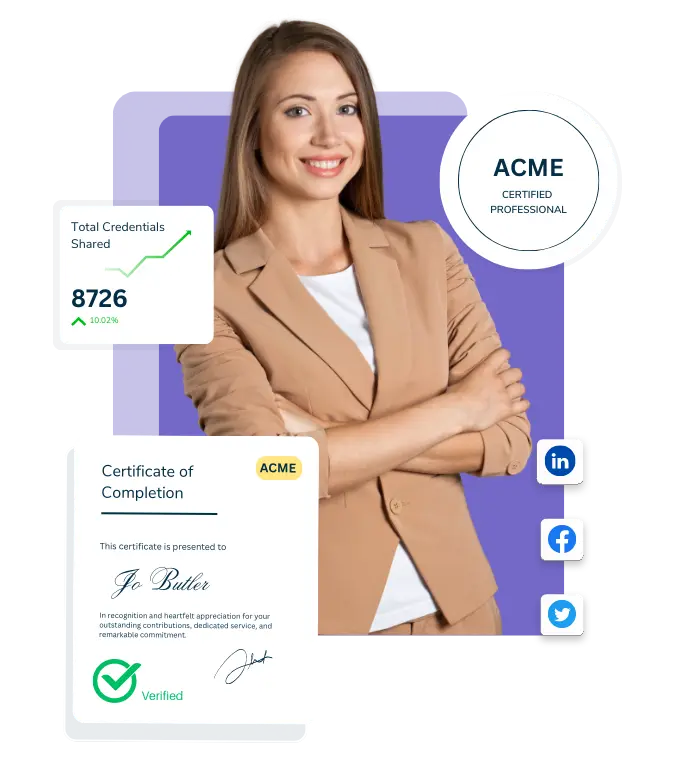
Give learners a portable record of their achievement—not just a badge image. An issued credential can be shared by link or added to a learner profile, social channel or wallet where the receiving service supports it.
Keep the issuer, achievement and evidence connected to the same record so each shared link carries context.
LAYER 02 STANDARDISATION
Use shared standards to support exchange.
Keep issuer, achievement and evidence together in a structured credential. Open Badges 3.0 and the W3C Verifiable Credentials data model give compatible systems a shared way to exchange and check that information.
Standards support portability, not universal acceptance. Receiving-system support, access to issuer keys and status resources, and institutional policy still matter.
More than a badge image Issuer · achievement · recipient · criteria · evidence · status · proof concepts
LAYER 03 VERIFICATION
Give reviewers a record they can check.
Give employers and institutions a way to examine the issuer, achievement and evidence—not just a badge image. A compatible verifier checks cryptographic proof against an issuer-controlled public key and establishes how that key belongs to the issuer.
A unique ID or QR code can locate a record; it does not prove authenticity. Checking an Open Badge also means examining its issuer, recipient, achievement, criteria and evidence, alongside compatible proof, schema and applicable expiry, status or revocation checks.
Important limits A valid signature does not prove learner competence or imply automatic issuer endorsement. DID or HTTPS issuer references may support key discovery where available; a DID is not required for every credential.
What a careful verifier checks
- Proof integrityVerify the signature with the issuer-controlled key. Altered signed data must fail validation.
- Key provenanceConfirm how the key is associated with the issuer, using supported DID or HTTPS references and a trusted issuer context.
- Credential meaningInspect the AchievementCredential fields and the evidence and criteria—not merely a certificate image.
- Current standingWhere the format and issuer provide them, check schema, expiry and status or revocation information.
LAYER 04 SKILLS & TAXONOMY
Make your program’s skills easier to understand.
Describe the skills a program is intended to develop, then relate your institution’s terms to a shared vocabulary. Give academic, careers and employer-engagement teams a clearer language for the learning behind an achievement.
LAYER 05 COMPREHENSIVE LEARNER RECORD
Connect achievements without losing their origins.
Bring credentials, skills, coursework, projects and experiences into a coherent learner record—with each source and issuer kept visible.
Your institution sets stewardship, consent and access rules. A Comprehensive Learner Record complements the authoritative transcript; it does not replace it or merge distinct evidence into a single claim.
Your institution stays in control Govern access. Preserve where each record came from and what it actually says.
LAYER 06 WORKFORCE & CAREER CONTEXT
Show how learning connects to workforce needs.
Consider program outcomes alongside employer-relevant skills and occupational contexts. Help your curriculum, careers and employer-engagement teams discuss program relevance and future learning pathways.
INSTITUTIONAL OUTCOME
Bring your credential strategy together.
With CertifyMe, your institution can connect the credentials it issues with the learning they represent, the records it governs and the workforce contexts learners explore.
Support clearer credential sharing, coherent learner records and better-informed conversations about program relevance—without losing sight of who issued each record or what it proves.
Let’s talk about your institution Discuss credential access, learner records and governance with CertifyMe.



.webp)